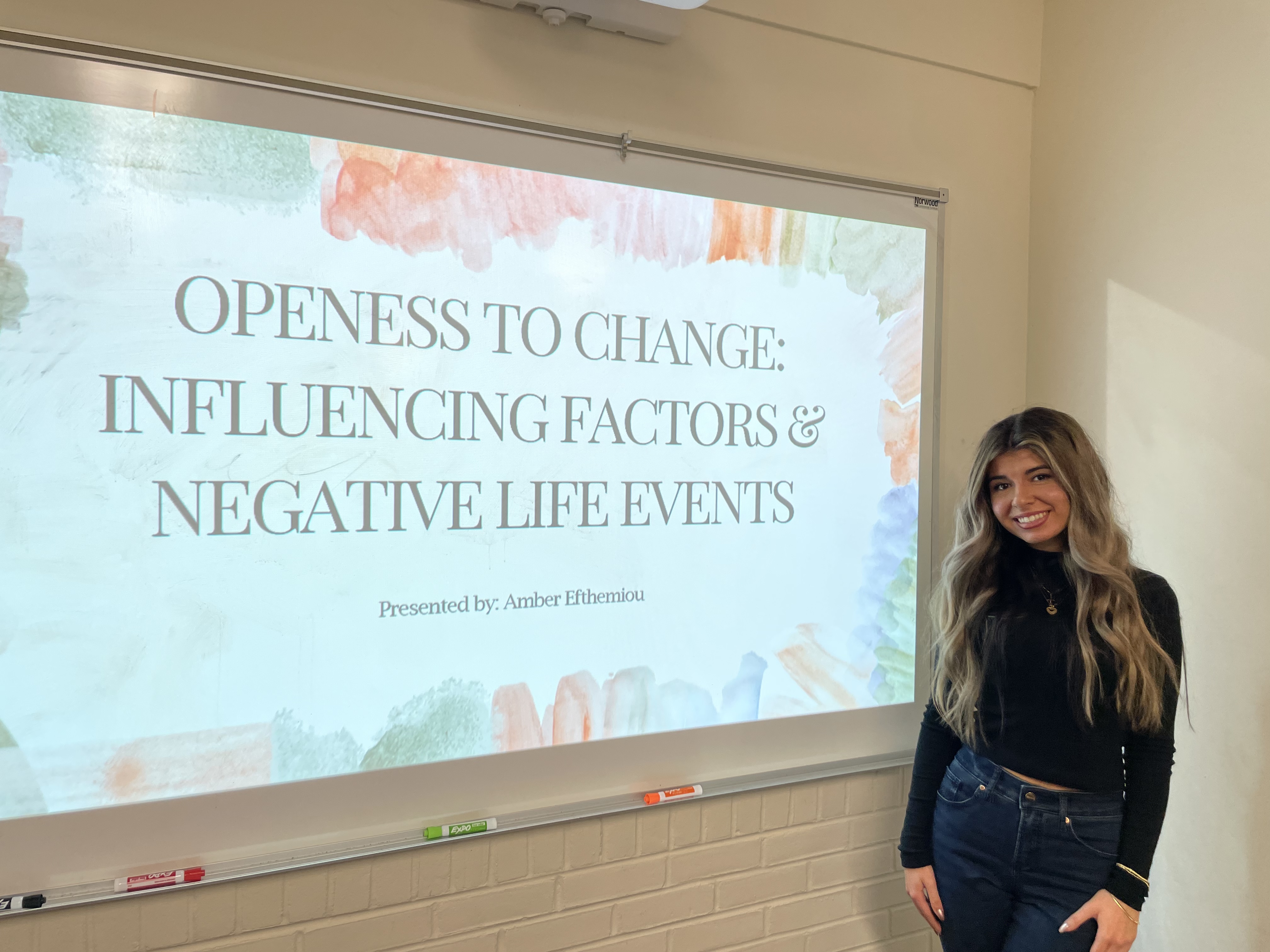
Amber, a third-semester undergraduate research assistant, recently completed a presentation in which she shared ideas about her independent study that she will be working on titled “Openness to Change: Influencing Factors & Negative Life Events”.
Amber described the background of this study by explaining optimistic beliefs (believing good things will happen) and its ties to resilience as well as the idea of pessimism (believing bad things will happen). She also explained how prior experiences shape our view points to point out the fact that if someone has experiences a multitude of traumatic events, ot may cause them to feel “unlucky” or that they are more susceptible to negative events than others.
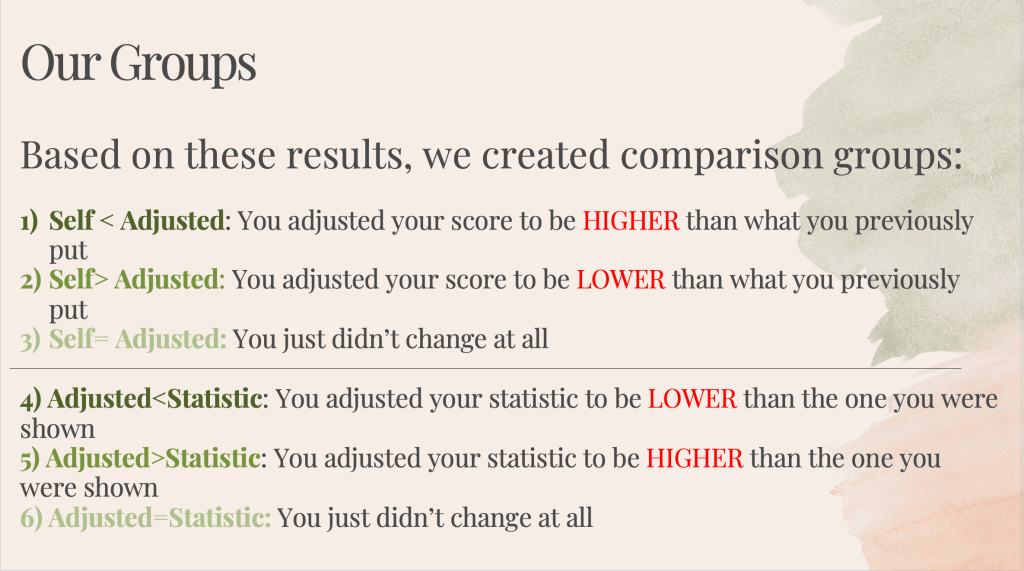
With that, Amber had worked on her own version of the Belief Update Task which was separated into three steps. The first presented the participant with 20 life events (e.g., ‘robbery’) and asked to estimate how likely the event is to happen to them in the future and how likely it is to happen to other college students in the United States. Then, information: presented with a fictional prevalence rate of the likelihood of event happening. Lastly, Second Estimate: asked again to provide estimates of their likelihood of encountering the same events. After splitting the sample into 6 different comparison groups (shown in the slides below) this study hypothesized that “people who rate themselves as more likely to experience negative life events when shown a lower statistic will show less openness to positive likelihood change for negative, uncontrollable life events”
The procedure of this study included participants completing a pencil and paper survey where they answered the edited Belief Update Task as well as measures such as the Brief Resilience Scale, indication of trauma events, and LOT-R. To analyze the data, Amber ran a Factor Analysis as well as multiple one-way ANOVA’s for each event.
We saw differences in optimism and pessimism between some groups (e.g., changing statistic to become lower (”better”) vs keeping it the same) for events such as getting robbed, having a heart attack, and developing a brain tumor. However, pessimism and optimism may not be exactly opposite as Amber noted. It was also found that trauma events seem to not specifically affect belief updating, and resilience was only seen to affect belief updating once, in updating belief about being robbed to be higher or lower (nothing for staying the same).
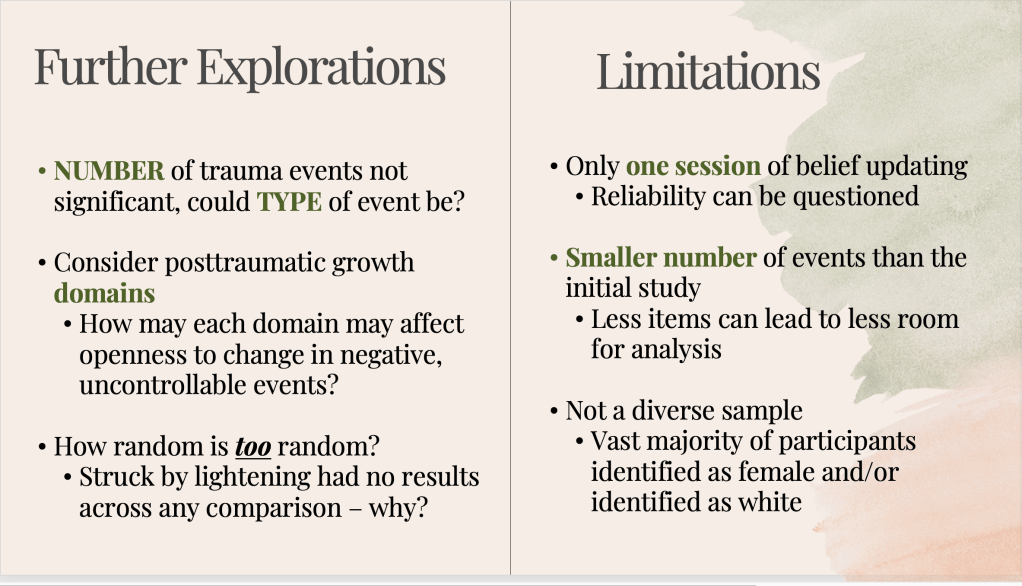
Limitations of this study include the fact that there is only one session of belief updating, so reliability may be questioned as well as the diversity of the sample. Future directions include looking into which traumatic events may affect the belief updating of the participant or how each hypothetical event’s lack of change could be do to the randomness of the event itself.
We are looking forward to hearing more about Amber’s research. She has done a wonderful job presenting her findings, and we are ecstatic to see what she completes next!
 FF-TIP LAB