Paxton Hicks, a first-year graduate student and former lab manager, captivated our attention with his recent presentation on his thesis proposal titled “Depenetration Process of Self-Disclosure”.
Paxton is intrigued by the exploration of Self-Disclosure, a deliberate process involving the communication of personal information to another individual, and its impact on intimacy. The concept of intimacy, in this context, encompasses both the nature of the shared information and the quality of the relationship itself. Engaging in Self-Disclosure not only fosters increased relational intimacy but also results in heightened liking, enhanced life satisfaction, and, ultimately, a greater propensity for sharing information with more breadth and depth. The Social Penetration Theory underscores that as we acquire more information about a person, the depth of that information intensifies, progressing from superficial details to core aspects such as fears and negative attributes. This interplay aligns with the depenetration process, where individuals become less open or revealing over time, potentially leading to a shallower level of connection in a relationship. This thesis aims to identify depenetration processes and observe the point at which individuals begin to recede their own self-disclosures.
The hypotheses of the study are as follows: H1: Participants’ intimacy towards a peer will correlate with the point that an individual decreases their own self-disclosure during depenetration. H2: Participant decreases of self-disclosures will differ between whether peer disclosure or reciprocation decreases. H3: Participant decreases of self-disclosure will differ between friend and stranger figures. H4: Participant’s degree of self-disclosure with a given individual will influence the point of depenetration
The study will have a Quasi-Experimental, 2×3 repeated measures factorial design requiring 366 participants. The participants will be randomized into 6 groups, complete the Parental Closeness Measure (PCM), the Self-Disclosure Questionnaire (SDQ;JSDQ), complete intimacy sorting to decipher what information is more or less valuable per each participant, and a depenetration task.

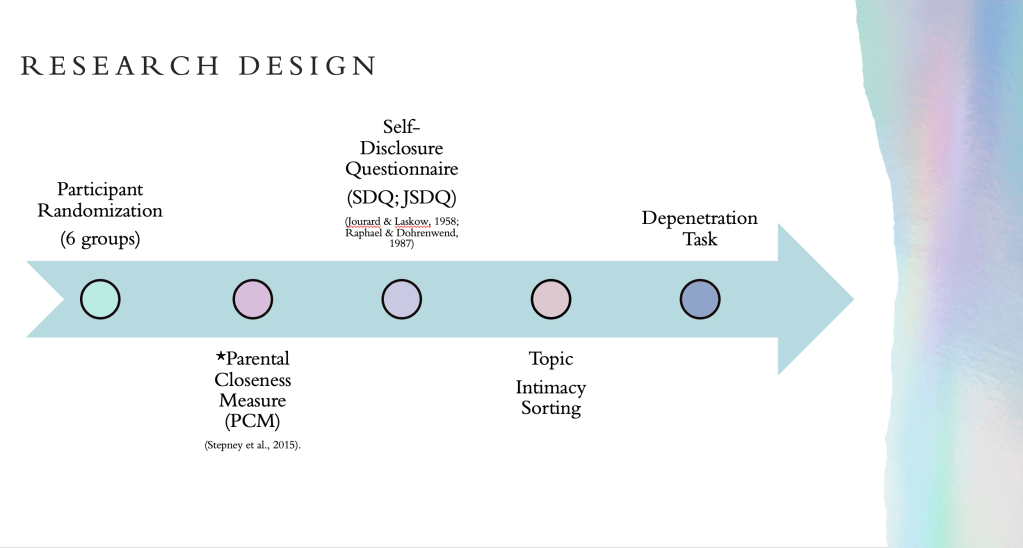
The depenetration task includes a non-disclosure version containing statements like “They stop telling you about how their day went” and “They stop talking about what they’re interested in.” The non-reciprocation version features statements such as “You tell this person about your day, but they do not tell you about theirs” and “You talk to them about a topic you are interested in, but they do not share anything in return.” The repeated measures involve the following questions: (1) How likely are you to share superficial information? (2) How likely are you to share opinions and beliefs? (3) How likely are you to share deep and personal information? Additionally, there is a text box provided for question (4): “Would you voice your concerns to this individual regarding this recent behavior?”
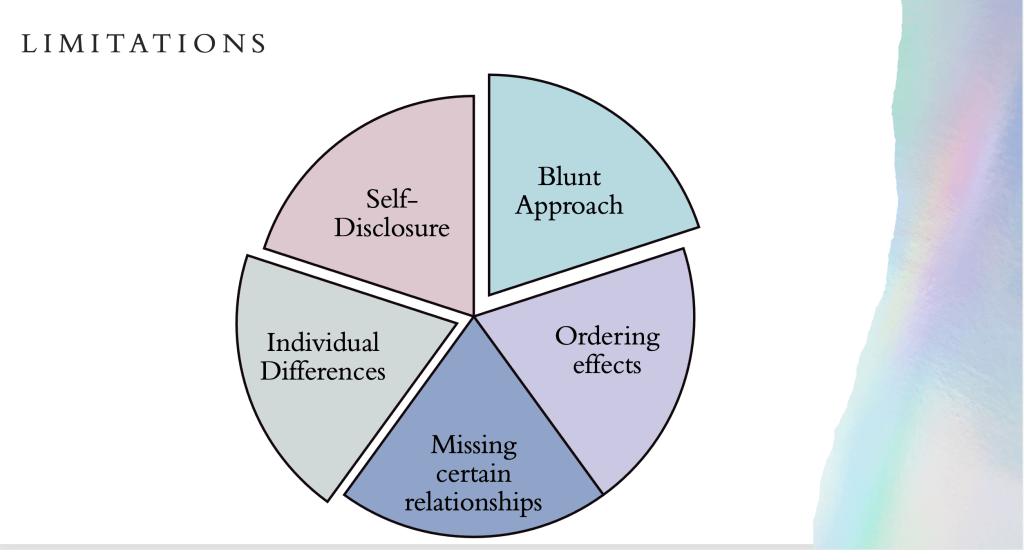
The limitations of the proposed study include individual differences, ordering effects, and what is considered a blunt approach to Self-Disclosure that is replicated during this study.
Congratulations, Paxton on proposing your research successfully, and we are so excited to see this stellar proposal come to life!
 FF-TIP LAB