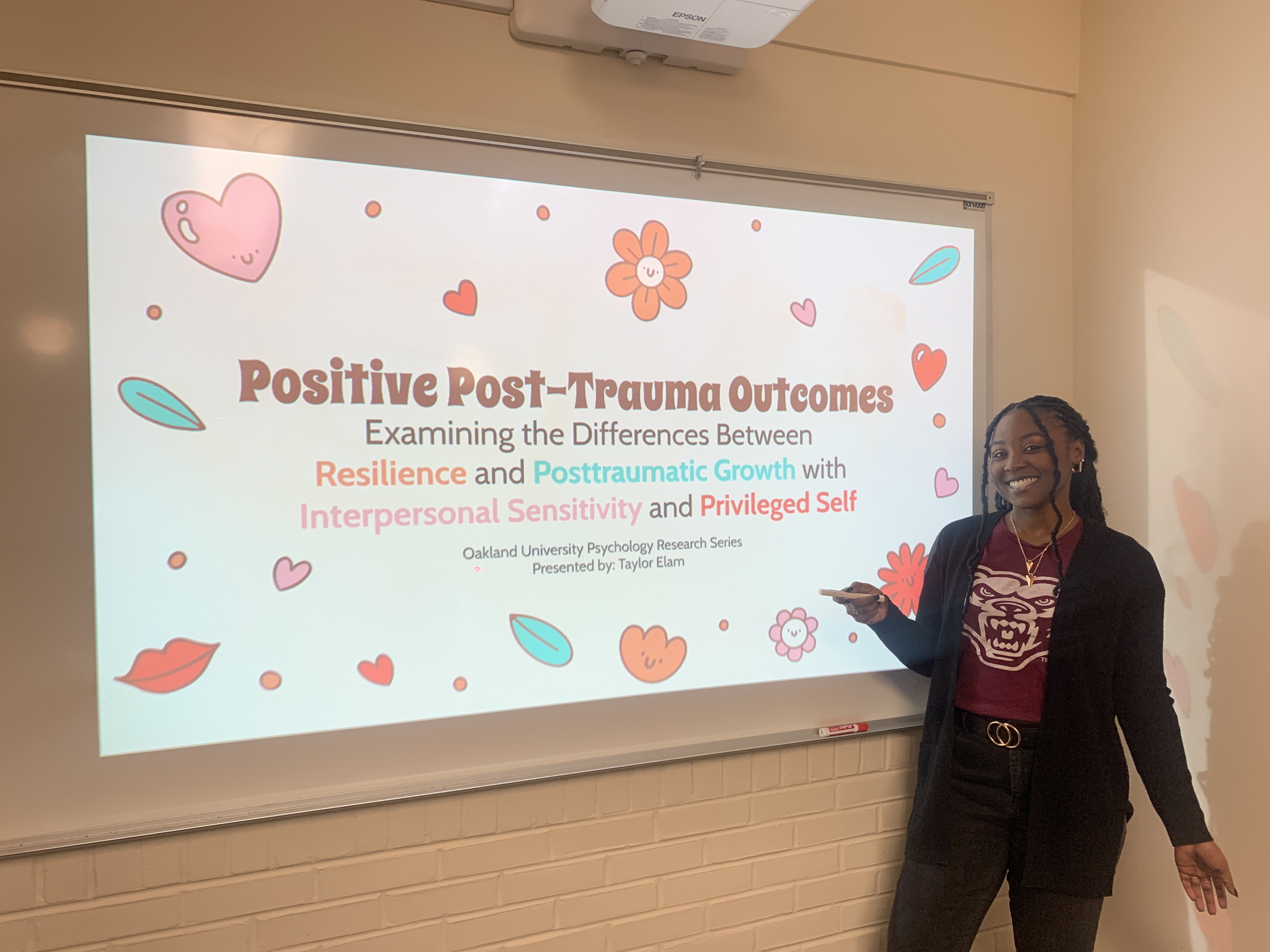
This past week, Taylor Elam, a current PhD student in the FF-PTG Lab, gave a presentation in preparation for her departmental talk this week. She started out by explaining some of the pertinent topics that related to her thesis such as resilience, post-traumatic growth (PTG), interpersonal sensitivity, and self-privilege.
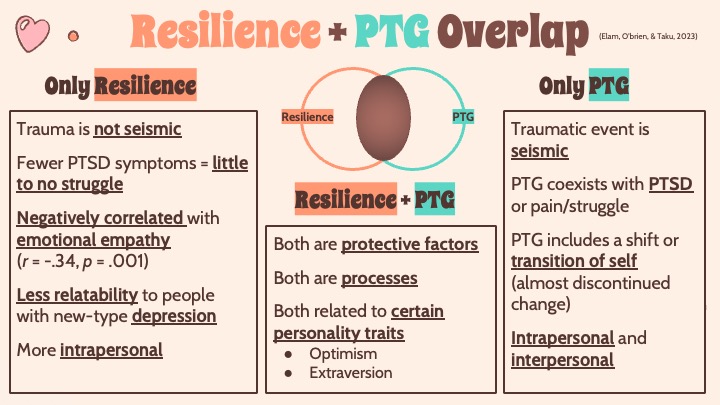
Here at the FF-PTG lab, we are no stranger to the concept of PTG, and in her presentation, Taylor expanded on this topic. She provided helpful examples of what post-traumatic growth can look like in real life, furthering our knowledge and understanding of what PTG is and what outcomes it can lead to. She also noted the distinction between resilience and PTG. She explained that while both can lead to positive psychological outcomes and that both can be related to personality traits such as optimism and extraversion, the two terms should not be used interchangeably. When people experience PTG, they often have faced a seismic traumatic event that led to pain and struggle. When people experience resilience, on the other hand, they may not have perceived their trauma as seismic and tend to have little to no struggle. Additionally, experiencing PTG tends to be both an intrapersonal and interpersonal process, while experiencing resilience tends to be a more intrapersonal experience.
Taylor noted that these distinctions are important when it comes to applying both PTG and resilience. She discussed that resilience can be a protective factor against depression, and therefore knowing about its unique qualities could lead to intervention programs addressing symptoms of depression.
Taylor explained two additional concepts during her presentation: interpersonal sensitivity and self-privilege (“privileged self”). She described interpersonal sensitivity as the tendency to worry about or react excessively to others’ negative evaluations. She noted that self-privilege is the tendency to pursue one’s pleasure prior to striving for harmony with others.




After providing us with the pertinent information regarding the variables she addressed via her research study, Taylor then began to break down the current study. She went over the purposes and hypotheses related to her study. She then broke down the methods used to conduct her research. After discussing these important factors with the lab, she went over the results of the study, which revealed interesting findings about the relationship between resilience, interpersonal sensitivity, and self-privilege.
After presenting the results, implications, and future directions of her study, Taylor allowed her fellow lab members to provide feedback and suggestions. During this discussion, many of the lab members provided constructive ideas that Taylor would be able to apply to her departmental presentation. We are proud of Taylor for her work on this study and look forward to seeing her finalized presentation this week!
 FF-TIP LAB