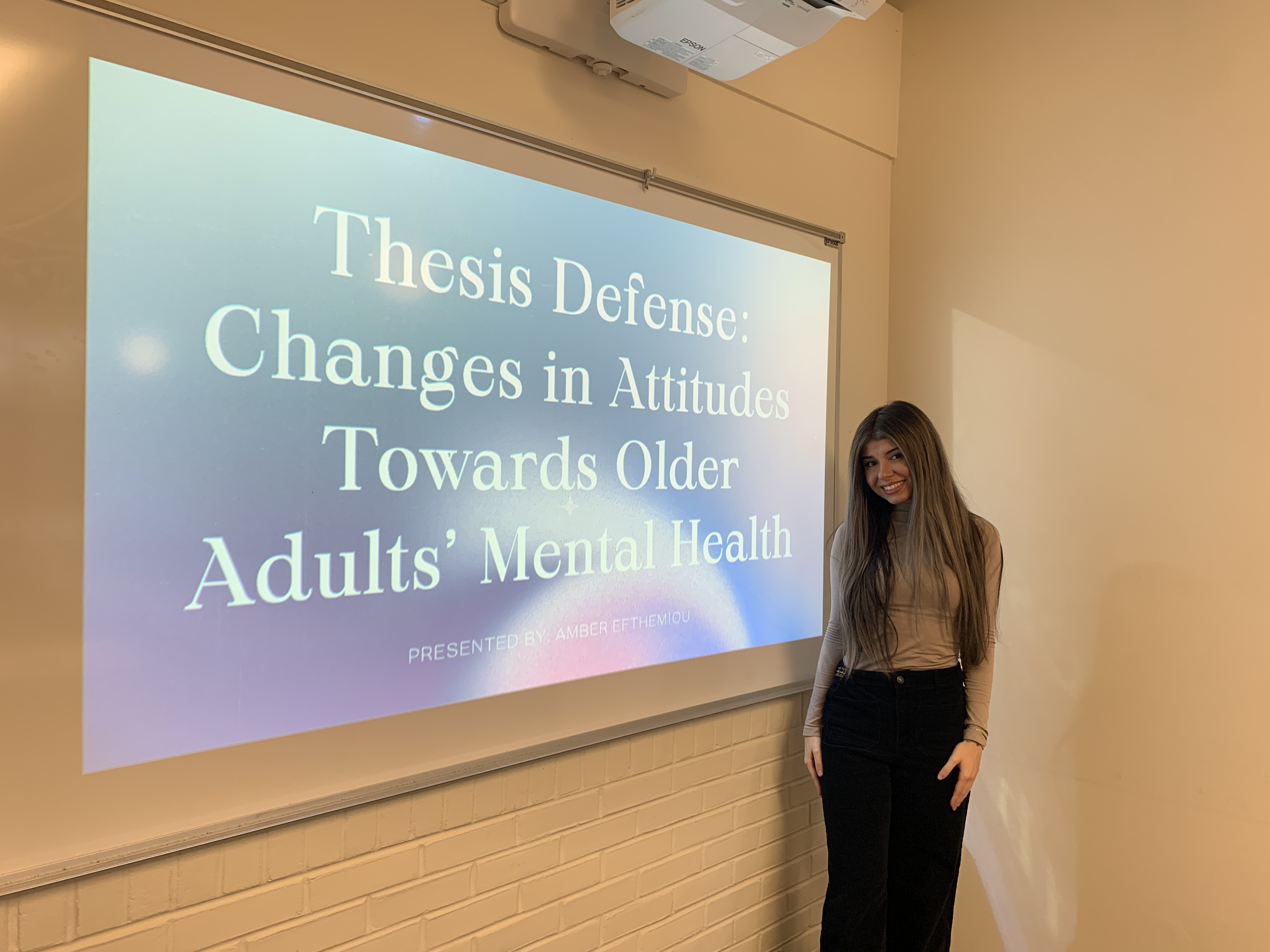
Amber Efthemiou, a fourth semester undergraduate research assistant and the current lab manager of the FF-TIP Lab, presented her senior thesis defense to the lab this past week. Amber has been working diligently on her senior thesis over these past few semesters and the lab was very excited to learn about the findings that her study garnered. Her current research focuses on changes in attitudes toward older adults’ mental health and the data collected for the purposes of this study revealed a variety of interesting results once analyzed.
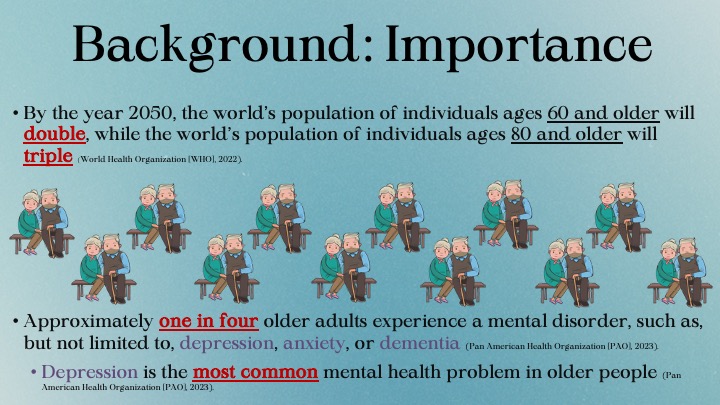
Before getting into the specifics of her current research, Amber took a moment to explain why her senior thesis came to be in the first place. She presented information about why researching attitudes toward older adults’ mental health is important. One of the facts that Amber presented is that by year 2050, the world’s population of individuals 60 and older will double. Additionally, approximately one in four older adults experience a mental disorder (e.g., depression, anxiety, dementia). Based on these facts alone, it is clear that research in this field is extremely relevant with the world’s population continuing to age.
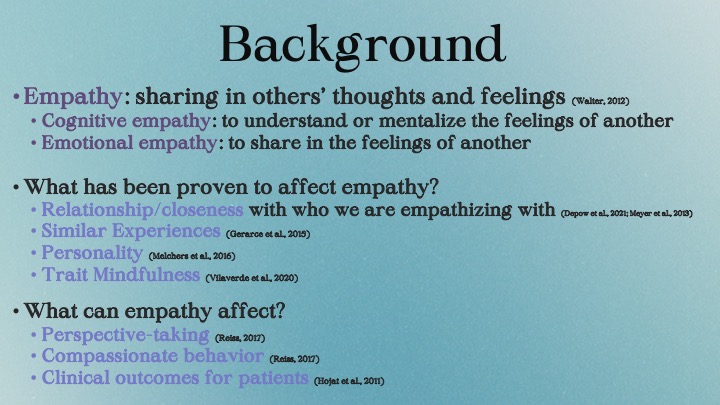
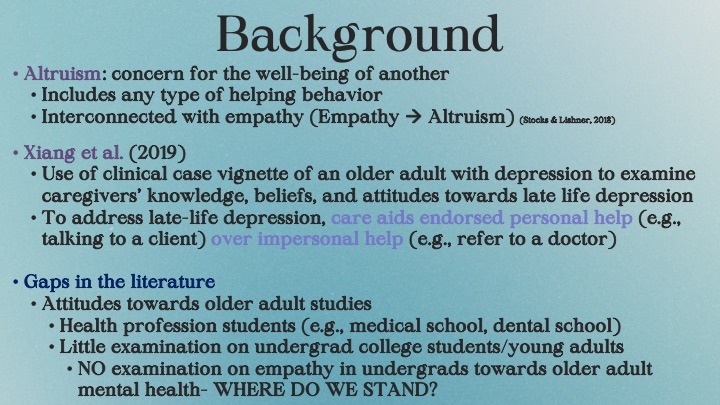
After setting up the importance of her study, Amber provided some pertinent information regarding the variables that she would be addressing in her research. Amber explained the difference between cognitive empathy and emotional empathy. Cognitive empathy is the ability to understand or mentalize the feelings of another person, while emotional empathy is being able to actually share in the feelings of another person. Amber also defined altruism, which is the concern for the well-being of others.
After providing background information and defining empathy and altruism, Amber explained the gaps in the literature surrounding this topic. She noted that there is little known about how undergraduate college students and young adults view older adults’ mental health. For this reason, she decided to conduct a study on this very topic. Through her research, Amber wanted to expand the understanding that we currently have regarding peoples’ attitudes toward older adults’ and their mental health. She wanted to look at how being related to or close to an older adult might influence a person’s ability to empathize with an elderly person.

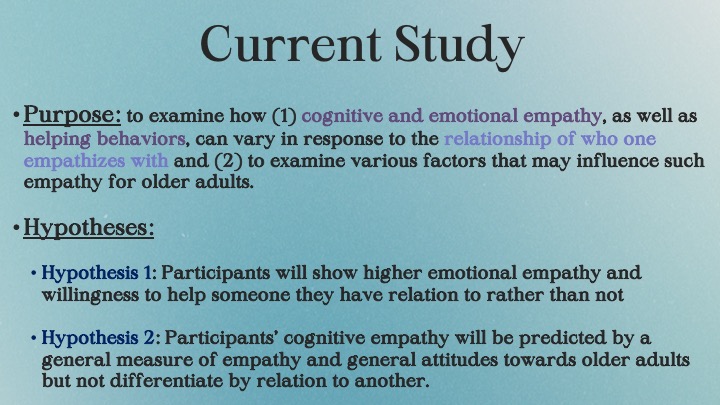


After describing her hypotheses and purposes for this study, Amber went on to explain the methodology behind her research. For example, she informed us of the various scales she used, the demographic information of the study’s participants, and the data analyses she conducted. She was able to show that having a relationship with an older adult can impact how a person empathizes with said older adult. The implications of these findings are plentiful. For instance, knowing that having a relationship to an elderly person with a mental disorder may lead to greater levels of empathy for older adults can allow for the improvement of healthcare for the aging population. If healthcare professionals have strong working relationships with their clients, they may be able to provide greater levels of care.
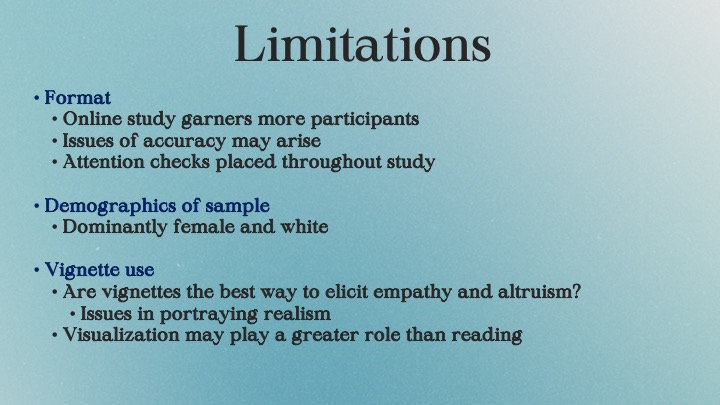
The findings presented by Amber during her senior thesis defense were very insightful and certainly contributed to a greater understanding of how college students view older adults. However, it is also important to mention the limitations of this study. One of the limitations of this study is its online format, which could have led to accuracy issues. It is important to note that Amber did include attention checks to avoid inaccuracy. Additionally, her study could have had a more diverse sample, with the majority of participants being female and white. She also used vignettes in her study to elicit empathy and altruism. It is possible that the vignettes did not portray realism.
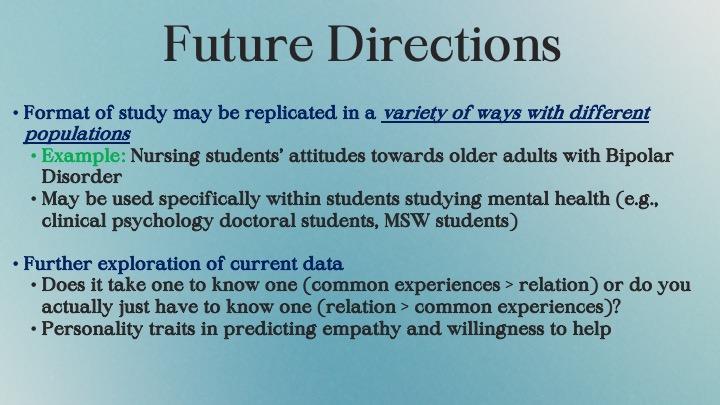
Despite the limitations of this study, Amber’s findings are very important and could lead to future research in this area. For example, it is possible that this study can be replicated for different populations to address specific mental health concerns. It is also possible to look at how personality traits play a role in individuals’ attitudes towards older adults.
We are very proud of all that Amber has accomplished! We can’t wait to see what is next for Amber as she continues her academic journey and research into the field geriatric clinical psychology!
 FF-TIP LAB