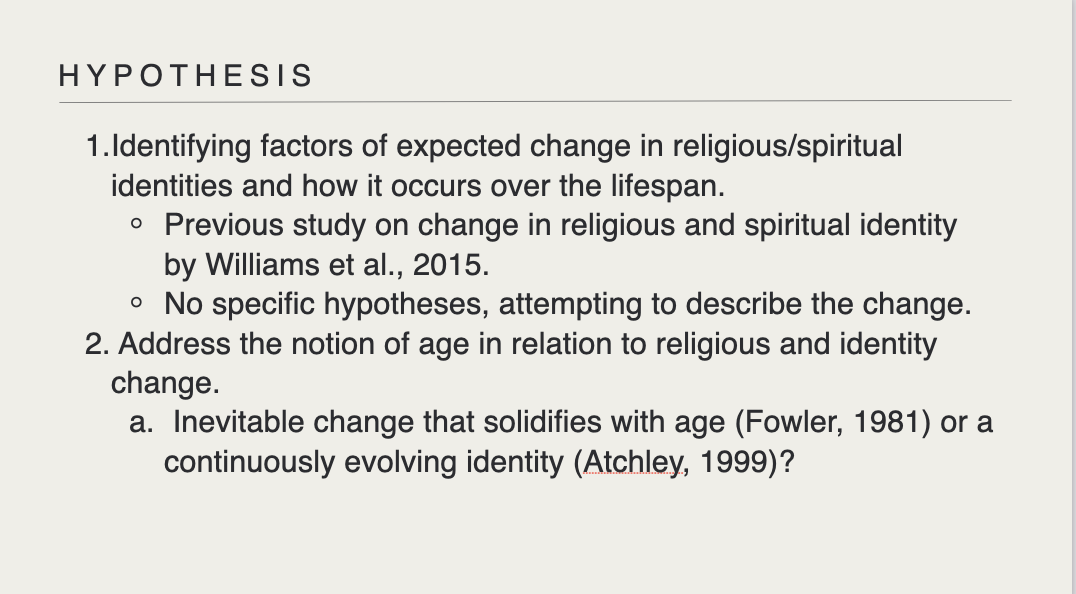
Last week, Gina Reyes, a first-semester undergraduate research assistant at the FF-TIP Lab, presented an article on religious and spiritual identities and how they change over time. The article, titled “Religious and spiritual identities: evaluating change over time, identity salience, and the influence of aging” by Neal Krause & Gail Ironson (2024), aimed to identify the factors influencing a change in one’s religious/spiritual beliefs in relation to age.

Gina identified the author’s objective as identifying the factors influencing a change in one’s religious/spiritual beliefs, specifically regarding age. She provided further background information by defining religious and spiritual identities and identity salience. As described in the presentation, religious identities are one’s involvement in organized institutions that have a system of beliefs and practice specific rituals and behaviors. Furthermore, spiritual identities are an individual’s subjective way of relating to the sacred regarding beliefs and emotions about purpose, the afterlife, and the supernatural. Lastly, identity salience is the extent to which an individual places value and importance on a specific role and how often it is significant across various situations.
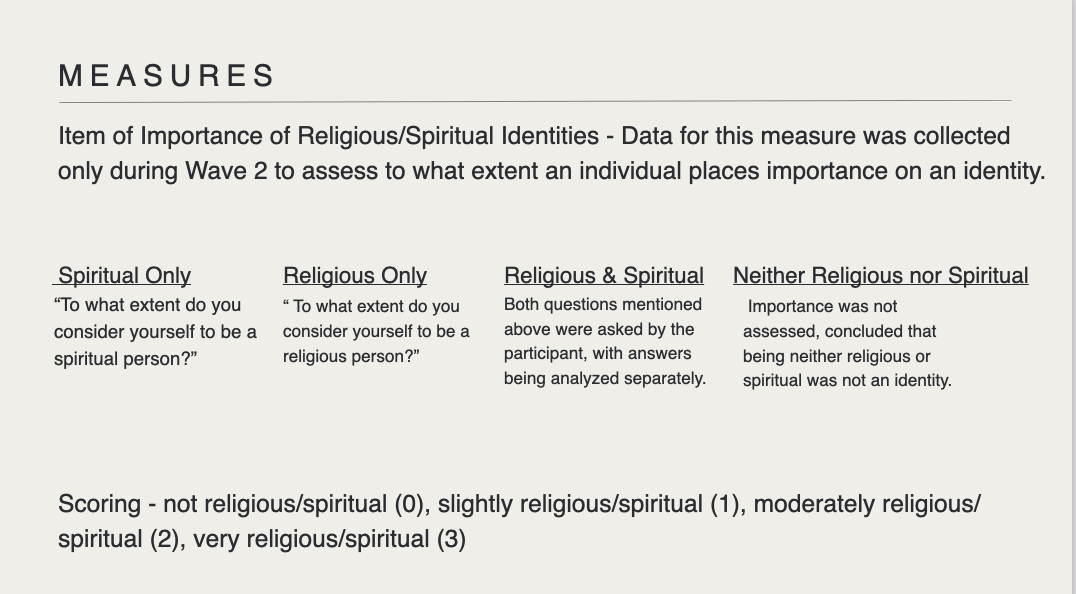
Gina then outlined the research methodology used in the study. Data collection took place in two waves. The first wave involved using the Zinnbauer Four-part Scheme to categorize participants into four identities: Religious Only, Spiritual Only, Religious and Spiritual, or Neither Religious nor Spiritual. In the second wave, participants ranked the importance they placed on each category. For example, participants were asked, “To what extent do you consider yourself to be a spiritual person?”. The response was rated on a Likert scale of 0-3 (0= not religious/ spiritual, 1= slightly religious/spiritual, 2= moderately religious/spiritual, 3= very religious/spiritual).
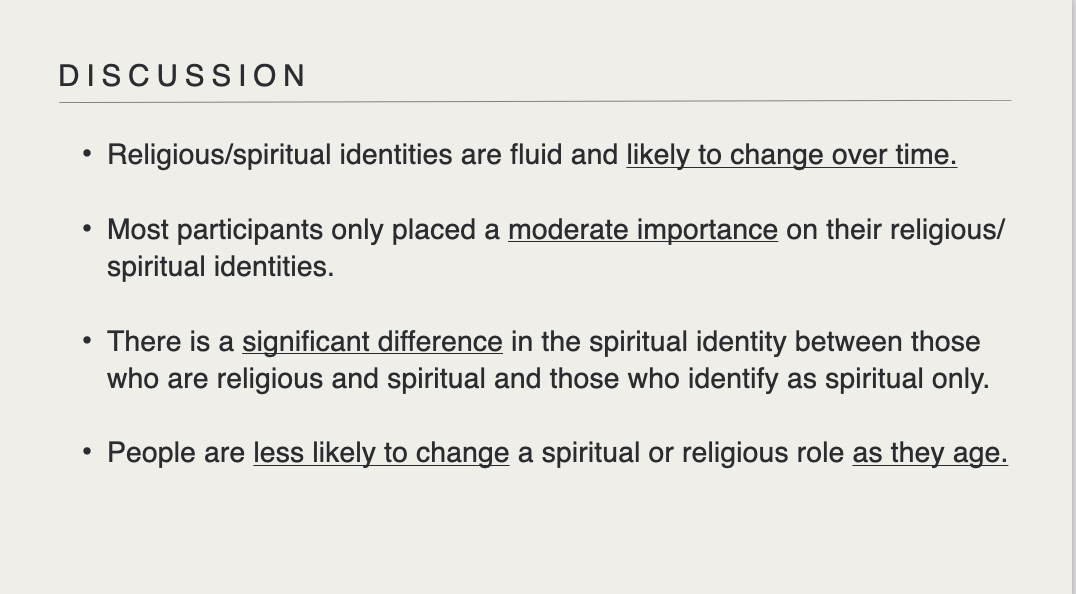
The study found a negative correlation between age and the likelihood of individuals leaving their spiritual or religious identity, indicating that while these identities change over time, the rate of change decreases with age. Gina noted that the majority of the changes in religious identity occurred in the spiritual-only group. She identified that this is possibly due to a lack of understanding between spiritual and not religious identities or the lack of group reinforcement and structured beliefs within spirituality.




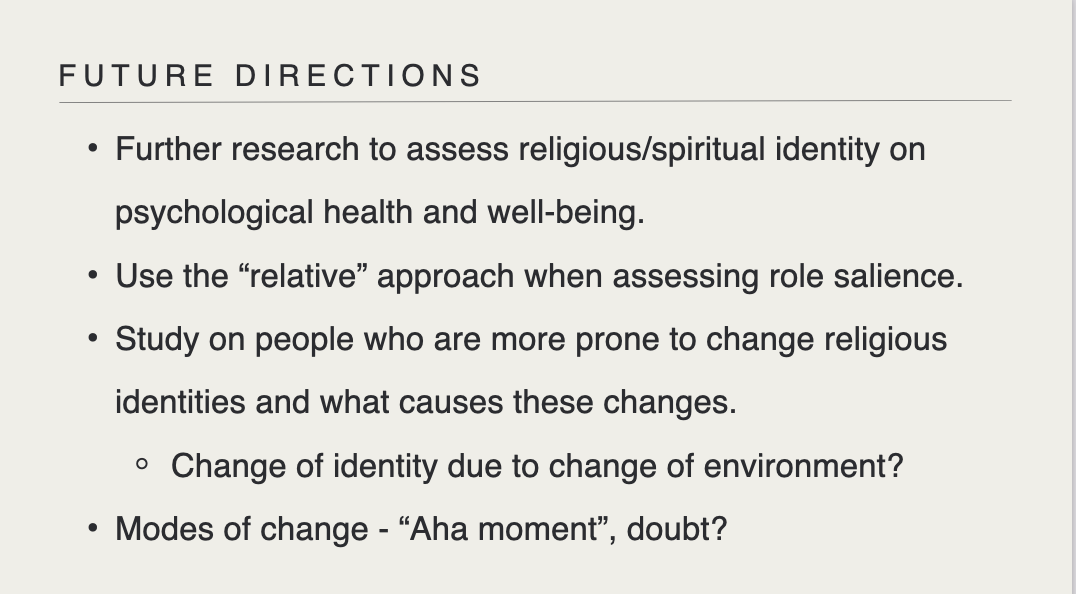

To conclude the presentation, Gina highlighted the study’s limitations and suggested areas for further research. One significant limitation was the loss of participants between Wave 1 (n= 3,010) and Wave 2 (n= 607). There were various reasons for this low response rate, but it ultimately reduced the usable subject pool. The lower subject pool for participants with certain identities is another limiting factor of this study, as it did not allow the researchers to explore the age differences between changes from specific identities. Future research has the potential to explore the modes of change between identities, environmental effects, and the impact of spiritual/religious identity on psychological health and well-being.
We appreciate Gina’s insightful presentation and look forward to seeing how her research interests develop further.
 FF-TIP LAB