Last week, Ana Samaneigo-Ramos, a first-semester undergraduate research assistant at the FF-TIP Lab, presented an article on the effects of self-talk on competitive anxiety, self-efficacy, volitional skills, and performance in young athletes. The article, titled “Effects of self-talk training on competitive anxiety, self-efficacy, volitional skills and performance: An intervention study with junior sub-elite athletes” by Nadja Walter, Lucie Nikoleizig & Dorothee Aldermann, aimed to assess the efficacy of a self-talk intervention on improving sports performance and its effects on other aspects related to competitive sports.
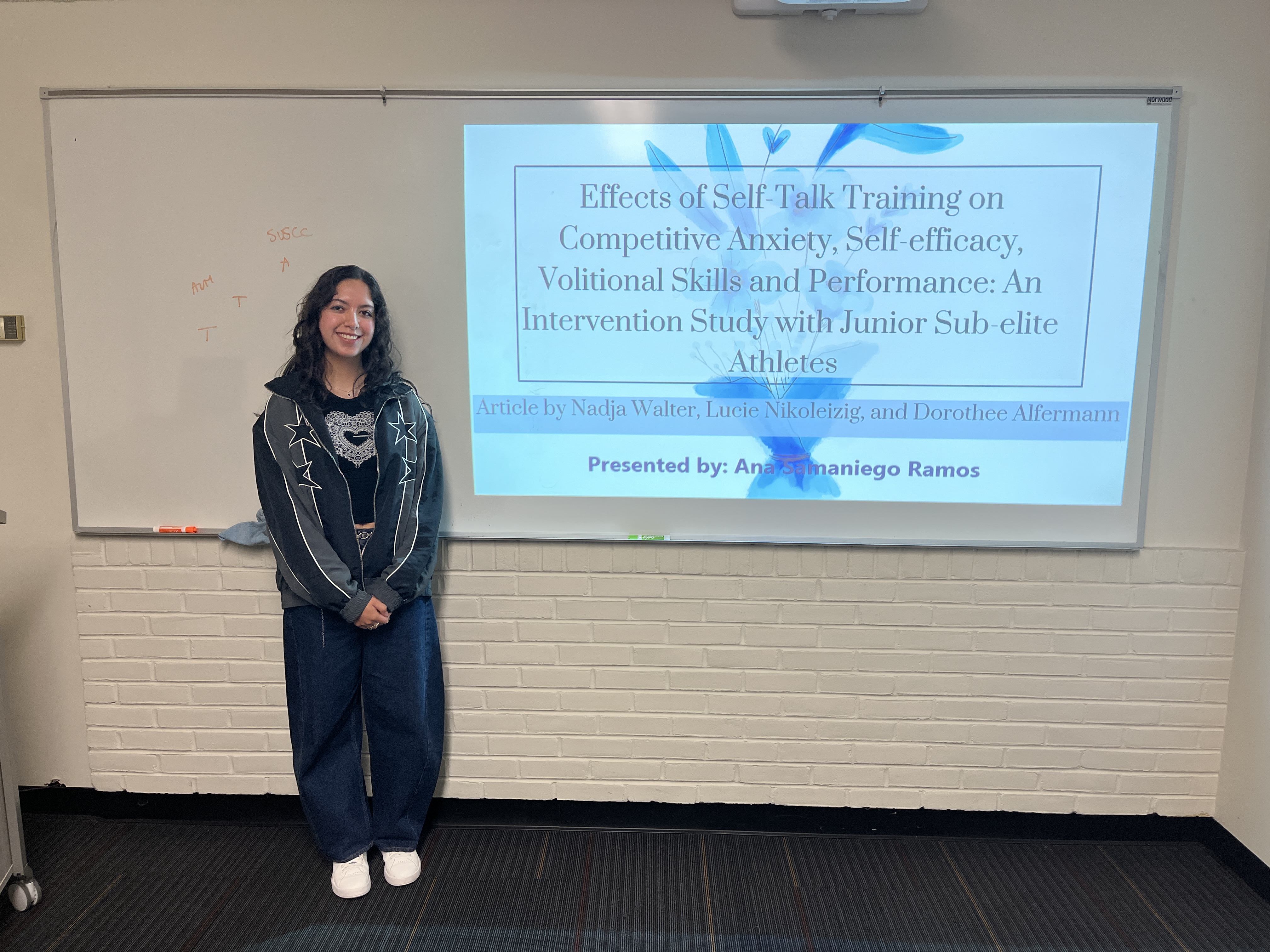
In her presentation, Ana explained that the authors aimed to explore the effects of a self-talk intervention on various traits related to competition, such as anxiety and self-efficacy. She also provided background information on the cognitive systems behind self-talk and its effects on behaviors. Ana shared that, while self-talk has some effects on motor learning and athletic performance, the effects on performance in competitions and personality traits are unclear. Furthermore, it is unclear how a shorter intervention versus a longer intervention affects these variables.
Ana then described the research methodology used in the study. Participants completed surveys at three different time points: before the intervention, right after the intervention, and again 5 to 6 weeks later. There were two intervention groups that participants were randomly assigned to: the short self-talk intervention program (three hour-long sessions in one week) or the longer intervention program (three 20-minute sessions each week for eight weeks).
Overall, the study found that there was an increase in self-efficacy across time points for both the short and long-term interventions. There was also an increase in performance from the long-term intervention; however, this effect was not observed in both the short-term intervention group or the control group. There were significant changes in personality across time points for both intervention groups.
To conclude her presentation, Ana discussed how she might implement the concept of self-talk into her own research interests of belongingness in the context of cultural identity and cultural adjustment. We look forward to seeing how Ana’s research interests develop!
 FF-TIP LAB