On April 4, 2025, Taylor Elam and Gina Reyes presented a study, “Moral Filters: Investigating How Personality Affects Perceptions of Behavior Change”, at the Graduate Student Research Conference at Oakland University.
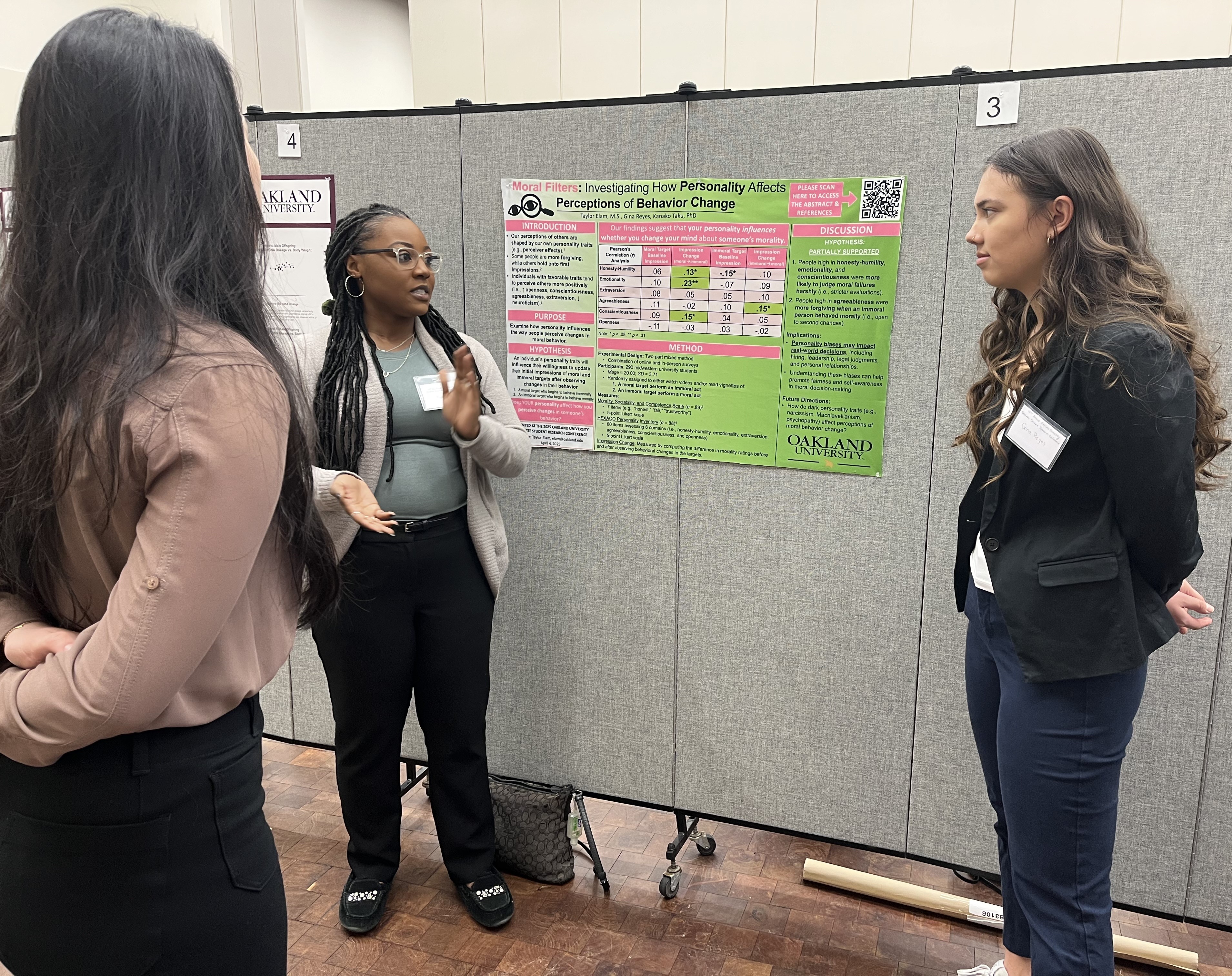

This study was based on Taylor’s master’s thesis. Prior studies suggest individuals with favorable traits, such as low neuroticism and high extraversion, openness, agreeableness, and conscientiousness, tend to evaluate others more positively. We hypothesized that personality traits influence participants’ willingness to update their initial impressions of moral and immoral targets after observing behavioral changes (i.e., a moral target behaving immorally and an immoral target behaving morally). Our results partially supported our hypotheses, and results suggest specific personality traits may influence responses to observed moral and immoral behaviors. Emotionality and conscientiousness were linked to sensitivity to moral failures, reflecting a heightened awareness of ethical norm deviations. High agreeableness correlated with positive updates for immoral targets behaving morally, indicating openness to change and forgiveness. Future research should explore how dark tetrad traits impact impression rigidity, offering further insights into individual differences and perceiver effects.
 FF-TIP LAB